


Carpenter's Corner: Types of Staircase Design and Their Purpose

Updated: Feb 24

On today’s edition of Carpenter’s Corner, we’re going to be sharing different stair design builds and their purpose. If you’re working with an architect to design a new build, this is a great opportunity to research and learn about different stair aesthetics and their footprint. Learn about the safest options for stair builds as well as the most stylish looking staircase designs. Find out which staircase will work best in your home during renovations, and how to update your staircase to safer options from an outdated one.
We’re even including a special note about spiral stairs versus circular stairs, a subject that sometimes trips up homeowners when working with stair builders or updating older homes and businesses. By the time you’re done, you’ll be an expert in types of staircase design and their purpose, just like the stair carpenters here at Pinto Carpentry!

Straight Stairs (With and Without a Landing)
This design of staircase covers stairs without any change in direction, making a clear linear path from top to bottom. They’re the most common type of stairs you’ll see in residential and commercial properties alike. They are the most cost-effective and classic build style. Most homes have these stairs descending into basements or ascending into a loft or attic area. For lengthier sets of stairs, you’ll most often find a landing inserted to break up the height; most buildings require this for floor heights greater than 12 feet tall or under 16 risers in total.
These are most prominent in building plans as they’re the easiest to ascend and descend, as well as being the most straightforward in building process. They need only be connected at the top and bottom without any additional structure required to support them. This type of stair is also easier to work with for handrail installation with regards to measurements. These are sometimes more difficult to add into a building after the fact, as they do take up a significant amount of room, so plan accordingly to lose significant floorplan space if adding them to an existing structure.

Quarter Turn Stairs (L Shape)
This is a variation on the straight stair. Two straight stair portions are connected by a bend and landing, most usually at 90 degree angles. This type of stair is a little more difficult to build than your typical straight stair, and requires more complex planning. In general, a support is typically required to anchor the landing piece, most notably built into the surrounding walls so it is not visibly disruptive.
This design works well as an addition to your space, as the turn can enable it to be placed in corners and take up less room, or wrapped around an existing structure like a central wall or support. It can also help add a little bit of a visual and noise barrier and divider between floors. When fitting this type of staircase for handrails, it does require a bit more nuance and precision for a continuous system around the 90 degree turn.
These are common in split-level homes, townhomes, and many modern designed interiors. The central landing design is also considered to be safer as it provides a natural resting spot and reduces risk of falls than climbing longer straight stairs.
* Winder stairs are a variant on the L shaped stair. Instead of the large area flat landing, they have what we refer to as a “pizza slice” or tapered step. This pie shaped triangular step at the corner transition is great for small space areas where the stairs need to turn. This type of stair is often featured in older homes with less space or where it will be utilized as a secondary stair access point. It can also be found in many larger historic Victorian and Colonial homes as this was often used as an access point for house staff for cleaning, serving, and kitchen access so they did not mingle with the main home residents or guests.
The compact design of a winder stair makes them a very attractive option in sustainable designs and small-space dwellings. The disadvantage here is that unlike the landing with wide space, this narrow winder slice stair is a little harder to navigate and provides less room for your foot. It can also be a little more challenging for railing measurements and installation due to the tight angle, requiring an experienced eye to properly fit handrails most safely.

Switchback Stairs (U Shape)
When it comes to spatial efficiency, this is the king of kings. This design features two parallel flights of straight stairs joined by a central landing point which creates a 180 degree turn. These are significantly easier to fit into most architectural plans, and add a significant visual interest and design to the building, however, they are more difficult to build than a Straight Stair or Quarter Turn Stair as they fit into a very small space. These are a great option for individuals experiencing mobility issues, children, and the elderly.
This staircase design offers a wonderful flow and central visibility point in the dwelling, creating a look of open flow. To measure for this type of stair, your carpenter will be evaluating for adequate room for the landing and turns, and it is more laborious to install due to the tighter space and complexity of design, and requires an experienced craftsman. If adding this to your home during a renovation, expect this to take a little longer than your average stair install during construction. This works especially well for particularly tall buildings with multiple floors, as it creates a central focal point for design aesthetics and gives ample space to rest and recharge between flights.

Scissor Stairs
This design is another space-efficient configuration when two interlocking, independent staircases cross one another in a singular vertical enclosure. When viewed on the plans, they’re spacially arranged in an interlocking criss-cross design like scissor blades.
This is most commonly used in very tall high-rises such as large apartment buildings or hotels, or high-rise commercial real estate like office buildings, schools, hospitals, and parking decks. This type of stair design offers multiple exit and entrance paths, creates efficiency when meeting fire code standards in tall buildings, and reduces overall floor area usage. However, in an emergency this can present a challenge for rescue workers entering and exiting the building due to their height and lengths; they can sometimes be disorienting. These are not to be confused with attic scissor stairs, which are a folding, accordion style expanding stair that folds up into ceilings for space safety.

Curved Stairs
Not to be confused with spiral stairs, this curved design follows a helical arc but has a much larger radius as they don’t generally meet a full circle. They have a tasteful swoop and curve, making them an incredibly attractive option for a central staircase in an entry way to your home or business.
These are very popular for new builds, as they add a gorgeous elegance and focal point. Rather than turning around a central column, they’re designed to enhance the flow of a space and offer a higher-end aesthetic and air of luxury. These do require a larger foot print than most stair designs, but they really do shine as a unique architectural detail.
Pairing this type of staircase with a rich, high quality wood for maximum impact, and handrail designs utilizing long lines of straight balusters or decorative panel designs can really add a lot of “oomph” to a home’s first impression on entry. Likewise, options with solid wall handrail design can add opportunity to install unique lighting for contrast and focus. A curved staircase does not make a complete circle.

Circular Stairs
A design similar to a curved stair, but once again not to be confused with a spiral staircase. Alternatively known as Helical Stairs. This design is another elegant, luxurious design but on the more conservative side for spatial footprint. Traditional circular stairs have a much larger radius than spiral stairs, and offer a more comfortable ascent and descent. This design generally turns more than 90 degrees and creates a central opening in the stairs as it goes around.
If you’re looking to make a statement with your build, the circular design adds a touch of glamor while still creating an open feel in a smaller space than a curved stair, without the claustrophobia and inconvenience of a spiral stair. Oftentimes homeowners and designers will opt to hang a decorative chandelier in the central “hole” for a unique focal point as people ascend and descend the stairwell. Consider this design as a turning sculptural element in the home for more visual appeal. If you’re going to be frequently accessing the upper portions of a home or business, but do not want the design to take up a large footprint of floor space, this is a great option.
Spiral staircases can create difficulty for most users due to their steep angle and narrow treads, and are extremely inconvenient for moving furniture; whereas a circular stair provides much more comfortable movement and ease of use.

Alternating Tread Stairs
This is a very uncommon staircase design, but when needed can add an incredibly space-efficient staircase with less than half the footprint of standard stairs. These are often included in tight spaces like lofts, attics, tiny homes, and mezzanine areas. The alternating tread design is much safer than your average ladder, as it allows you to descend and ascend with forward-facing views and better stability.
This stair design is generally for stair builds at a 50 degree to 70 degree angle, and features paddle-shaped trades so you can walk one foot down at a time. On your average normal stair, you’ll choose which foot you begin with, but with this design you place one foot on a single tread at a time. For visual reference, it looks almost as if there is a waterfall set of two half-staircases adjacent to one another. It’s a unique looking design and maximizes space efficiency in places like tiny homes and cabins especially, without wasting valuable floor area for things like appliances and living space.
Much like a spiral staircase, alternating tread stairs can only have one person ascending or descending at a time, as there’s no space for opposing foot traffic to step aside while using them. This design is typically preferred over a spiral staircase for safety and comfort of use.

Spiral Staircase
Many people have romanticized the idea of spiral stairs, but in practicality they’re the least efficient, and most uncomfortable stair to use. This design is considered less safe for children, pets, and the elderly, and is a nightmare to navigate for those with mobility aids. While they do add a bit of quirky charm to a space, they’re best suited to very small spaces and less-used areas of a dwelling. They’re crafted around a central support pole or beam with a very tight turn radius and minimal tread space.
This staircase also only allows for one person to go up and down at a time, as there is no room to pass someone else on the stairs. They’re very steep and narrow and that makes it highly impractical for moving large furniture pieces up and down to the secondary floor. More often than not, regardless of utilizing high-quality materials and elegant design options, a spiral staircase is a negative point for curb appeal due to their inaccessibility.
They’re a very impractical, steep design and whenever possible should be avoided. They’re most often found in historic homes as servant quarter entry or into loft spaces; some older buildings like urban apartments and estate homes may feature them as a historic architectural design point, but often replace them with more accessible, comfortable and space-efficient designs like a circular stair or alternating tread stair.

Floating Stairs (Cantilever)
This clever design offers the optical illusion that stair treads are floating on their own in the air with no visible support. The cantilever is a beam anchored on one end with the stair stringers attached in a concealed manner for a minimalist look. They create an airy, spacious look to any room and offer sleek, modern elegance. These stairs can be quite complicated to construct and do involve a lot of construction in the wall of the building to support the weight and torque of stair usage.
They’re more costly than a mono-stringer stair due to the structural requirements for safety and integrity over time; these stairs require the utmost technical precision in engineering to balance the weight load. Check out our older blog post featuring the science and design of cantilevered stairs in more detail!

Open Riser Stairs (Non Cantilever)
This type of staircase features the same modern, minimalist design aesthetic of the cantilever design but a little less complicated of an engineering feat. The staircase is created without the center vertical risers, often supported by central stringers or dual side stringers, as opposed to cantilever being anchored to the wall. This is a great option for a central staircase in the home or business’s entry way, areas like corner stairwells where you’d like to add more light, and maximizing the visual space of an area.
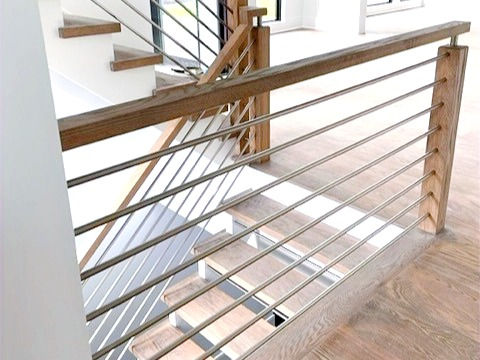
They’re great for bright, airy looking interior designs! For homes with elderly individuals, children, and pets, additional central support like stainless steel bars may be recommended to prevent slips and falls through the wide space of open risers. Additionally, some illusion of open risers can be created by installing thick specialty glass panes or plexiglass between the spaces while decreasing slips and falls through the space.

Bifurcated Stairs (Split staircase)
This split staircase design typically has a wide set of starting stairs at the bottom which ends at a landing partway up, with two narrower sets of stairs ascending off the main landing in opposite directions. When looking at the stairs from the center of a building, they often create a Y shape. Sometimes the central landing also leads off to a hallway or balcony area.
This is the design which requires the most significant footprint spatially. It is typically used in very large, open homes and commercial buildings with large “grand entry” spaces. It’s an impressive architectural feature in a space, but requires an immense amount of labor and precision for engineering as well as an enormous footprint. It’s also one of the most costly designs for stair builds due to size and labor.
Are you looking to repair your home or business’s staircase? Do you have a new construction plan requiring an experienced stair builder? Pinto Carpentry is here to get the job done! We’re available for commercial and residential projects with regards to new stair builds, updating older stairs for safety, repairing damaged staircases, and more.
Our team has more than two decades of industry experience creating bespoke stair builds designed with modern safety standards and precise engineering. Give our team a call and we’ll set you up with an appointment for a free consultation and provide you with a customized estimate.
Our knowledgeable staff can also assess your current stairs and provide you with the most efficient, safe options for your space.
We can’t wait to work with you! Now booking through March and April of 2026 (at the time of publication.) Just call Pinto Carpentry at (908) 922-1778. Visit our portfolio at our website for samples of past and present installations and design inspiration.


Comments