


Different Options in Home Improvement Projects to Increase Accessibility for Disabled Individuals


Did you know that more than 1 in 4 adults in the US have some type of disability? That’s right,
this is the one minority group around the world that basically everyone can expect to be a part of at some point in their lives. On today’s blog, we’ll be discussing some of the ways you can make your home safer and more comfortable for all ages of family members, while still keeping things stylish and personal to your tastes. It’s estimated that more than 1 billion people with disabilities exist globally, so it’s very surprising that more accessible features are not considered when building homes and offices!
Each of the renovation points on this list is to help create significant improvements in quality of life for disabled individuals. These changes can make your home easier to navigate and less risky for injury and accident regardless of mobility needs. Accessible home modifications can transition existing layouts from their challenging design options into something that perfectly fits your lifestyle. In recent years, multigenerational living has also been on the rise in popularity, leading some homeowners to amend their family home to accommodate multiple age groups and access needs. Additionally, many homeowners are opting to purchase older dwellings instead of custom crafting brand new homes for budget reasons, of course, and it means you may need to make some improvements to increase accessibility for disabled individuals.
Whether you’re making the amendments on behalf of a family member, or would like to have a more accessible, accommodating home for independent living, we’re here to help! From grab bars to handrails to widening entry ways and even smart home features, there are wonderful ways to modify your residence for greater ease. Here are some things you should keep in mind when planning renovations and upgrades to your home to accommodate disabilities.
Let’s explore the different options of home improvement projects to increase accessibility for disabled individuals

Replace any squeaky stair treads and risers, and any areas with visible damage to increase safety when ascending or descending floors. Ensure your stairs are completed with the following types of nosing which are generally safer:
Pencil Round - This nosing remains the most popular option as it suits all lifestyles and homes. This style features no rounded corners and no sharp edges, it appears as if a pencil has been laid at the edge of the tread. For households with children, elderly residents, or pets, this is the best choice as the edges are not sharp and don’t protrude excessively.
Half Round Nosing - This nosing employs a semi-circular, curved and rounded edge which protrudes slightly from the front of the stair tread. This gives the stair slightly more surface area, providing your foot with additional grip and support, making it a safer option. This is also sometimes referred to as “bull-nose” style.
Full Round - This nosing features a fully circular, completely smooth semicircle with a profile that protrudes from the front of the stair tread. It is a beautiful, elegant style, but as it protrudes more than other styles, it isn’t as “slip safe” as other choices.

Upgrade your indoor handrails to proper code. Pinto Carpentry regularly repairs, installs, and upgrades local New Jersey homeowner’s indoor railings on a regular basis, and you would not believe the things we’ve seen! Many older homes have damaged, loose, or outdated railings that are no longer safe and need replacing. Current code in NJ at the time of publication states that all stairways that are 44 inches or more in width should have continuous handrails on both sides, and stairways less than 44 inches wide may have a handrail on one side only. Safety codes can and will vary from state to state or town to town; check with local guidelines and building codes before starting any project.
Install and add stair gates to prevent falls. While commercial gates are available for the average consumer to purchase, generally made of metal or plastic, it’s important to remember they’re not one-size fits-all! As railing and stair professionals we highly recommend investing in professionally custom created wooden gates. Opting for customized gates may cost a little more in the budget, but it ensures peace of mind that they’re professionally installed for maximum stability, and have been precisely crafted to fit your exact space. This can also help prevent the elderly from slipping and falling or from tripping due to lack of use of mobility aids. They’re a worthwhile investment all around!
Opt for non-slip flooring in your home. Carpets and runners may cause slipping or tripping for those with an unstable gait. Removing the runners and carpeting on staircases, and replacing it with anti-slip grip tape and anti-slip stair nosing will vastly improve safety for elderly household members. Other options like cork plank, low-pile carpet (“indoor/outdoor”), luxury plank vinyl, textured porcelain, and even rubber flooring can provide additional traction for safety and grip. Keep walkways and hallways free and clear of obstacles to improve mobility and access and reduce fall risk.

Improve the lighting in your stairwell. Adding professionally installed LED strips to the stairs themselves, as well as running LED rope light to the skirtboard or moldings can help increase visibility. Ensuring there is a light switch at the top and bottom of the stairs that controls stairwell lighting can encourage children and elderly family members to remember to switch the lights on before walking up or down. There are also some very stylish options specifically designed to light the edge of the treads and nosing on each step if you’re concerned about style and design. Bright, clear overhead light such as recessed LED lighting or large pendant lighting installed with proper headroom may also provide adequate light sources. In a pinch, you can opt for stick-on battery operated or rechargeable puck lighting. If you’re in a new build or renovation project, consider installing emergency lighting triggered by power outages to ensure enhanced safety during emergency situations. For residential staircases, a warm white light between 2700K to 3000K is recommended; it’s easy on the eyes and provides clear visibility. Your electrician can advise you on the proper lighting source location and levels.

Install accessible amendments to your stairs and entry ways. Consider adding a ramp for mobility aids such as canes, walkers, wheelchairs, and powerchairs to move freely in and out of the home. You can also opt to widen entrances and exits to the home to accommodate mobility devices as well when installing the ramp. Adding a stair-lift to your multi story home can make movement between floors much more accommodating for those with mobility challenges or debilitating joint conditions, as well as those who need mobility aids. Have a medical professional demonstrate proper use of any new mobility aids on stairs, and make sure all household members know how to properly operate and troubleshoot. Consider leveling the floors and transitions between room to room to reduce tripping hazards.
Upgrade your bathroom with accessible safety features. Shower and tub grab-bars can provide stability and balance in the slippery, humid environment. Roll-in or walk-in shower and bath options with wider entrances and low-profile flooring can be much safer, too. Reapply an anti-slip textured coating to your bathtub or shower floor, or add a weighted or suction-free safety mat if you need a less permanent option. When replacing toilets, consider height as an access need – those with joint issues may have trouble bending or squatting down for lower toilet heights, and a “comfort toilet” may be best as they’re higher; if someone is transferring from a wheelchair or powerchair, however, sometimes lower height models may be easier to access. To accommodate multiple accessibility needs, toilet grip bars are another fantastic option to provide stability for several disabilities and aids at once.
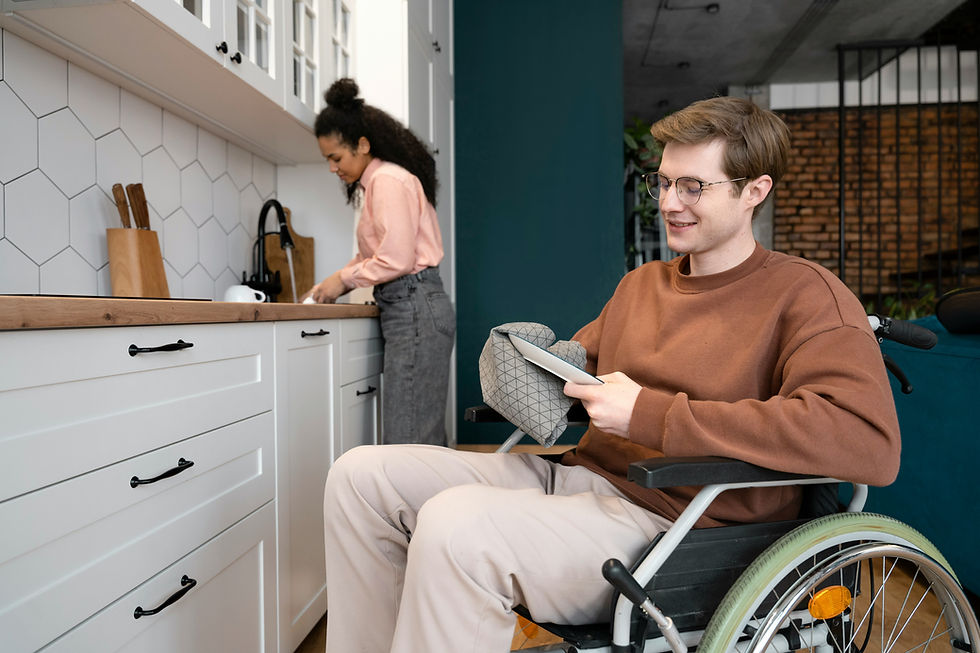
Make doors more accessible for people with mobility needs. Consider widening openings to a minimum clearance of 32” but ideally 36” to allow power chairs, wheelchairs, and walkers to pass through safely without interference. Ensure your door sills are no higher than ½” height to prevent tripping or catching wheels on mobility devices. Install lever-style handles instead of round doorknobs for those who may have trouble gripping, twisting, or pinching, and make sure they can be operated with one hand. Reduce the opening force of all interior doors and closet doors so they require no more than 5lbs of force to open, and consider a soft-close feature to slow the door swing for additional safety. Additionally, you can install an automatic door opener that can generally be push-button or voice activated, or in some cases even motion activated.

When redoing your kitchen, consider access needs and smart home appliances. If you’re modifying a home for mobility aid access, many wheelchairs and powerchairs sit lower than the average counter. Dropping the kitchen counters to 29” tall height can greatly improve access and independence in the kitchen for food prep. Opt for appliances with french-door models for easy opening, or consider under-counter or drawer refrigerators to eliminate height issues. Mounting any wall-ovens or microwaves at counter height can greatly improve access and safety, too. Make sure you select ranges and cooktops with upfront or side-mounted knobs and control buttons so mobility aid users don’t have to lean and reach over burners. Front-loading dishwashers are your best otion and many of them can be adjusted to have front-mounted control panels and wider access doors. Many brands offer ADA compliant speciality lines with their appliances, but you might have to special request them or order online. Selecting models that have smart-home capabilities for voice-activation and hands-free operation are a great choice for increasing independence and improving access.

Opt for better lighting throughout your home. Upgrade your lightbulbs to modern LED or smartbulb options. This not only cuts down on your energy and electric bills, but allows you to get much brighter lighting and increased visibility for mere pennies on the dollar by comparison. LED lighting strips and lights added to stair risers can dramatically reduce fall and tripping hazards on your staircase by increasing visibility in notoriously hard to see areas. Pairing smart bulbs and automated timer lighting with voice-activated smart home assistance can be a wonderful accessibility upgrade! This can prevent disabled individuals from entering a home in low or no lighting while searching for a switch to turn them on, and instead provide instant visibility. Timer lights ensure that folks with limited mobility don’t have to be reaching to turn things on and off, and those with memory problems won’t forget and leave things on to run up the bill.
Consider keyless home entry models and security systems. For those who may have trouble gripping and turning items, a key may be an access barrier to entering or exiting the home. Smart home locks with keyless entry that are activated by an app or voice control are a wonderful alternative. Similarly, locks with number pad entry access or alpha-numeric passwords can be easily tapped with a mobility device or hands instead of a key lock. The downside to these systems is you’ll generally still need a spare level of key access as an option to the feature in case of power outages or battery depletion.
What are some ways you've found to increase accessibility for disabled individuals?
Special Note: Are you finding it challenging to afford the upgrades required for accessibility in your home? There are numerous organizations that can help offset some of the costs with grants and donations. Groups like the US Department of Veterans Affairs, AmeriCorps, National Council of State Housing Agencies, Self-Sufficiency Grant via Modest Needs Org, and more offer financial assistance to help you make the changes you need!

If you’re looking to upgrade your home or business’s staircase and indoor handrails to meet accessibility needs and requirements, or wish to add easier access to renovated rooms and/or additions in your home, we’re here to help! The team here at Pinto Carpentry has more than two decades of industry experience in creating custom indoor handrails and bespoke stair builds to suit any home style. We’ll do our best to find you the perfect match for your home’s style aesthetics and budgetary requirements. Our knowledgeable and friendly office admin team will set you up with an appointment to get you a custom quote and top quality materials within your price range. Give us a call or DM us on social media today, @PintoCarpentryNJ on Instagram and Pinto Carpentry on Facebook!


Comments