


Learn About Stair and Railing Code in New Jersey

Stair and Railing Code in New Jersey - What Homeowners Need to Know

When you’re embarking on the journey of a home renovation or a large project upgrade like new stairs or railings, navigating the ins-and-outs of permits, building codes, inspections, and regulations can be a little overwhelming. The good news, though, is that it doesn’t have to be as mysterious as it seems, with a little bit of help that is; the crew here at Pinto Carpentry understands that this type of process is not part of our customers’ daily lives, and we’d love to lighten the burden of the process for you. We’ve been in the business for more than two decades, and have learned a thing (or twenty) about local New Jersey building codes, so we can shed more than a little light on the topic for you!
On today’s blog, we’re going to demystify some of the nitty gritty behind stair and railing code, so you can feel confident and happy during your renovation or repairs. We’ll dive a little deeper into the rules around handrail height requirements, stair safety code, and basic building code requirements for New Jersey, and build up your knowledge base so you can navigate project convos like the pros!
All About Stair and Railing Code Requirements in New Jersey and Why Code Compliance Matters!
The first thing you should know when considering building, improving, or remodeling a home, is that you must consult with a licensed professional to ensure that all building materials and projects will be up to code. Your builder will function as a sort of project manager, a liason between subcontractors, suppliers, and your local city/town officials to navigate what permits and approval is required before beginning your construction project.
As we’ve mentioned before, we do really love a good DIY project now and again, but for certain items, hiring the pros who are knowledgable in building code is a must! When you cut corners on steps like this, pardon the pun, you’re risking both personal injury and structural integrity of your home; not to mention, poorly done renovations or repairs can lead to quite a hassle down the road if you ever choose to sell, as inspectors will ding these as items to correct, leading to costly repairs right before moving, or even the dissolution of a sale completely. Keeping things professional and working within these vital safety parameters ensures that everyone will be able to navigate the stairways safely, and provide you with longevity and reliability for future sales and incoming homeowners later on. You should never take shortcuts or attempt to bypass a railing staircase code, as these are measures taken to ensure your home, family, guests, and pets will be as safe as possible.
A great way to ensure you’re doing things safely is to get at least 3 customized quotes from local contractors to compare and contrast the services. This will help you get an idea of who will be the best for the job, has the most experience, and will be able to abide most accurately to local guidelines and code. Choosing someone like Pinto Carpentry with two decades of experience and established relationships with local officials and inspectors is also very helpful! The likelihood of variances and renovations being approved are much higher when the cities and towns know and trust your contractors well through previous and frequent partnerships.

What are the current rules of Staircase Code in New Jersey?
Let’s explore the current standards and practices for safety code with stairs.
In New Jersey, all stairways must be equipped with handrails installed not more than 34 inches or less than 30 inches in height, as measured from the top of the rail to the surface of the stair tread. Each flight of stairs must have handrails installed on all open sides; on one side of an enclosed stairway that’s less than 44 inches in width; on both sides of enclosed stairways 44+ inches or less than 88 inches in width; oh both sides and in the center of stairways for anything 88 inches or more in width.
As a standard rule, current code mandates that staircases are at a minimum width of 3 feet, but as long as you meet this minimum you can extend them wider as you see fit. Having a minimum width ensures that the stairs will be easy to navigate and walk on comfortably. Treads must also be in good standing and adequately repaired if any signs of wear or damage are present, and be clear of hazards to minimize slipping risks.
Staircase risers should be no higher than 7 and ¾ inches. This ensures that your stairs are not too steep when walking up them nor too low when descending. Variation between riser measurements must not vary more than ⅜ths of an inch between the greatest height and smallest height or it will become a safety hazard.
The step treads must have a minimum depth of 10 to 11 inches. This refers to the distance from the nosing (front step edge) to the rear. If a step has a nosing the requirement is a minimum of 10 inches, and if it does not then the requirement is a minimum of 11 inches. This ensures that descending your staircase is easy and you will be able to walk down steadily without feeling precarious. Additionally, if nosings are used they must be at least ¾ inch but no more than 1 ¼ inches beyond the riser below. Variation between the largest projection and smallest must not be more than ⅜ths of an inch for safety.
The staircase must also have adequate lighting which is able to fully illuminate the entirety of the treads and landings, and if there are 6 or more risers, there must be a required wall light switch at every floor to control the lighting. This ensures you and your loved ones will have far less spills and falls due to not being able to see, and reduces attempts to judge stair depth in the dark.
No matter where your staircase is located, there must be a minimum headroom distance of 6 feet and 8 inches vertically between the top of the staircase tread and the ceiling, especially if it’s an enclosed space. This is an average height requirement to prevent a need for people to duck, and allows them to walk safely upright while up and down the stairs. Some older homes or buildings may be considered “grandfathered in” to local building codes, as they don’t meet current standards, but are unable to be brought up to code due to space restraints; your town will be able to advise if certain areas must be repaired, updated, or amended or if they may be left as is. Working with an established contractor during the estimates and consultation phase can be a real asset here, as their experience usually gives you a solid assessment right off the bat on their first site visit!

Let’s explore handrail code requirements in New Jersey!
One of the things we really pride ourselves in at Pinto Carpentry is our expertise with handrail installation. We’ve seen quite a lot in our 20 years of installations, and we take pride in our accuracy and efficiency in crafting top notch railing systems. All of our handrails are built precisely to code and we love to craft bespoke solutions to create safer continuous handrails in even the most unexpected spaces! We’ve fit some unique systems into tight spaces and even very small, narrow stairwells to still meet code and craft a beautiful system to boot. Curious how that all works? We’ll walk you through the process so you can see the intricacies of railing code in New Jersey, and learn more about how the systems can be customized for your space, too.
In New Jersey, all stairways of 44 inches or more in width must have continuous handrails on both sides. Staircases less than 44” in width are permitted to have handrail on one side only. When the stairs exceed 88 inches, the stairwell is required to have a central handrail dividing the stairs into equal widths, with a max spacing of 66 inches.
Handrail height must be no less than 30 inches, but generally not project more than 34 inches above the nosing of the treads. This pattern is continued from the landing all the way to the top of the staircase, creating a parallel railing at even height all the way up. It is imperative to remember to measure from the leading edge, else your railing may be in violation of building codes. There may only be exceptions to a height over 38 inches if there is a transition between handrail and guardrail, or continuing between flights of stairs.
Each handrail should be a minimum finger clearance of 1 ½ inches between the railing and the wall to ensure it is easy to grip and use for stability, and it should be a continual clear path for the whole length. You can purchase handrail brackets that ensure your railing is of even width from the wall, and they should be placed. The handrail should not have more than a maximum of 3 ½ inches into the required stair width.
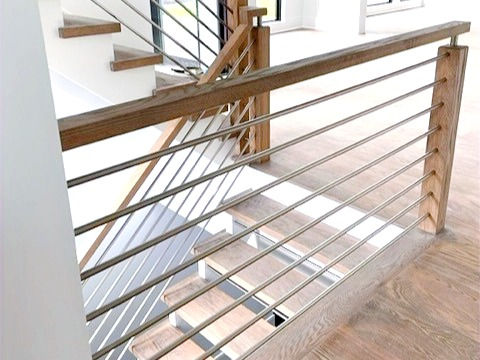
In the case of corridors, balconies, or landings with more than a 3 foot drop to the next level, there must be a guard rail installed. The guardrail prevents falls and injury from upper levels. It should be measured from teh top of the tread to the top of teh guard, and be not less than 30 inches in height. Parameters for this type of railing safety code include balusters being spraced not more than 8 inches apart, panels of wire, metal or other ornamental grill or walls providing protection in equivalent spacing as the balusters.
Your railing technician and installer will ensure that the new handrail system is up to date to provide safe movement up and down the stairs and between landings for you, your family, your visitors, and your pets!

What is the process for railing code and staircase code inspection in New Jersey?
Most renovations and home improvements as well as home sales will undergo an inspection process. In New Jersey, your inspectors will be measuring the home’s handrails and stairs against the Uniform Construction Code (NJUCC) which is adopted from the International Residentical Code (IRC). This measures the handrail height, guardrail and baluster spacing, grip size, uniformity of riser heights and trad depth for the entire flight of stairs, and strictly enforces limits on any variations. Unless a home is entirely new construction, most homes have some variations of code violations due to age and continual updates to local building codes. During inspections, your local official will be able to let you know what can be grandfathered in, if a variance is possible, or what needs to be amended to bring it to code before project completion.
Home inspectors are privately contracted and help provide a visual inspection of residential houses, and will leave you with a professional written assessment of the prospective home’s overall condition and quality; home inspectors are usually familiar with local coding regulations, but they are not in charge of building code enforcement. However, home inspectors can provide prospective buyers with a list of estimated repairs that are recommended to improve safety, and many of those may fall under code violations. Home inspectors differ from Building Code Inspectors.
A Building Code Inspector will examine and enforce local building codes for the city or county, and they can issue fines, require that codes are updated and corrected, and if no repairs can be safely made, they’ll condemn the property; they are not involved in the Real Estate process, only in construction and remodels.
We hope that this blog helped enlighten you and take some of the stress out of navigating handrail code, staircase code, and related railing and stair requirements in New Jersey!

Are you looking for Custom Stairs and Railing Installers in New Jersey?
If you’re looking for a carpentry company with industry experience and local expertise, Pinto Carpentry is here to help. With more than two decades of project experience building custom stairs and installing indoor handrails, you can feel confident we’ll get the job done right! Our master carpenters are ready to help you design an indoor handrail system that’s both beautiful and functional, and ensure that your stairs are reliable and safe for decades to come! Pinto Carpentry serves most areas of New Jersey, and we provide free consultations for customized estimates to both private homeowners and contractor builders. We’re available for residential and commercial projects alike! Just give us a call at 908-922-1778 to schedule your appointment and get on our books for 2026.
Note: At the time of publishing this blog, we’re booking appointments into June and July of 2026!


Comments