


Carpenter's Corner: Learn About the Key Terms and Parts of Handrail Installation


Here at Pinto Carpentry, we have been in the railing and stair business fore more than two decades. As a result, there’s a lot of terms and vocabulary that are a part of our daily job that might not be as common for the average homeowner. When you call Pinto Carpentry for a free consultation for indoor handrails, we’re sure that you’re going to hear some terminology that may be a little unfamiliar at first.
Things like balusters and newels, turnouts and s-turns…it can all be a little much to wade through during your renovations. But we want you to feel confident in navigating these tough areas of home improvement and renovation! So, take it from your friendly neighbourhood railing installer: it’s not as scary as it sounds. After you’re done reading our Carpenter’s Corner segment, you'll learn about key terms and parts of handrail installation, we bet you’ll be navigating convos with your contractors with a great ease.

We’re taking the mystery out of some terms and phrases used during railing installation, so you can select the materials and design that works right for you, and do so with confidence.
Here are some important words or terms you may hear during your consultation appointment for an estimate, or during the process of selecting materials followed by the actual installation:
Balcony/Balustrade - This is the protective barrier placed along the edge of a balcony, in which the primary purpose is to prevent people and pets from falling off the platform. This is a vital piece of infrastructure to any building design’s safety plan. There is usually a minimum height of 36”-42” and minimum spacing requirement to prevent children from slipping. It also provides additional stability and handholds for people when walking or standing on the balcony area. It can also be used to create distinctive spaces in upper levels and surrounding spaces.

Baluster/Spindle - This is the vertical piece that connects the baserail to the handrail of a balustrade lining the staircase. Balusters generally rest on a step or the floor. Spindles are usually supported by horizontal railing at the bottom, attached to posts. Sometimes the terms are used interchangeably. These can be made of wood or metal and come in a variety of aesthetic decor styles ranging from plain bars and rectangles to ornate and decorative stylings.
Banister or Handrail - A handrail supported by vertical balusters or horizontal posts, which runs alongside a staircase for support and safety grip. Can be used to express personal style with decorative elements. A single handrail is mandatory for any staircase with 3+ risers if riser width no wider than 43”, if wider than handrail both sides.
Baserail/shoerail - This is commonly known as “bottom track” or shoerail, as it runs parallel along the lower edge of your staircase spanning from top to bottom, and along the landing if needed. It supports and holdes the balustrade, secures spindles and balusters or decorative railing panels in their place.
Continuous Handrail - This style of handrail cannot be interrupted by newel posts, wall cuts, fittings, or other obstructions. It is one singular handrail running from the top riser to bottom riser of the staircase with no breaks. If you’re working with ADA code guidelines, this will meet those standards; it is excellent for those with mobility issues, allowing them to ascend or descend a staircase without having to remove their hand from the railing.
Diminishing Handrail - This is a specialized skill in handrail installation where the handrail angles upward and intersects with a ceiling, landing, or stringer into an acute angle. This requires custom measurements and precise joinery. The railing design diminishes in height relative to the tread, and spindles/balusters are cut shorter at the top as they approach the ceiling, maintaining a sleek, uniform look throughout the design while accommodating the angle and decreasing space.
End cap or Return - This is used to enhance safety, durability, and visual appeal of your handrail system by curving or closing it off flush against a wall, floor, or post. The end cap can be placed over the raw end of material for a smooth finished service, or you can have a mitered or wall mounted return with flush wall-profile or decorative rosettes.
Easing - This isa curved fitting used to connect different portions in the handrail for smooth transitions. Types of easings include a starting easing (curves up from a newel to join main handrail); gooseneck easing (uses a vertical piece of railing to join a sloped rail to a higher handrail to bridge the spatial difference); and an over/up easing (used to transition a rake/sloped rail to a level rail, generally at the top of a staircase).
Fillet - This is a decorative thin strop of wood used to fill the gap between balusters in plowed handrail and shoerail. It covers any gaps and spaces, creating a flush finish. It is made of the same wood species as the handrail for a clean, uniform look.
Finial - This is a decorative feature of a handrail system, used to improve aesthetics and style of the staircase. In general, these are spheres, scrolls, spears, or knob like shapes atop a newel. They’re most commonly found in historic homes from the Victorian era. In some special instances, they may feature custom designs such as animals, spirals, lanterns, or urns for a more detailed look. There have even been instances where homeowners will elect to add lighting to the newel with a globe or lit lantern style. Modern designs generally have a plain newel without decoration or finial.
Guard Rail - This is a protective barrier to prevent a person from falling off a raised structure like a deck or balcony railing.
Handrail Height - This is generally mandated to be between 34”-38” per building code, measured vertically from stair nosing.
Horizontal rail supports - This is a structural piece created to hold and stabilize horizontal railing, balusters, and cables to prevent sagging and connect the rails to posts. Generally used for sections longer than 4 feet in length.
Landing or platform - These are flat, level areas between flights of stairs and are generally required after a certain amount of vertical rise. Generally 36” deep and the same width of the stairs.
Lambs Tongue - This is a decorative element that curls at the ends of a staircase’s handrail. This is generally done in an aluminum, steel, or wrought iron style handrail.
Lattice panel - This is a structural panel made from intersecting wooden pieces or strips that provide a combination of decorative and functional. Selecting a lattice feature can add a personal flair to any balcony, landing, or handrail system. It’s most often used in a cottage style or nautical style handrail system, but can be flexible to most aesthetics if custom. This can be done in a diamond lattice, square lattice, or even floral decorative patterning.
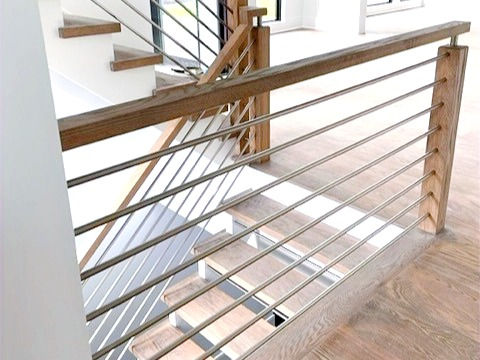
Materials (wood, metal) - Indoor handrails are constructed from a variety of materials, but here at Pinto Carpentry we generally use the wood and metal variety. Common material choices for indoor handrail are ash, red oak, white oak, poplar, and pine; more luxury finish options include mahogany, teak, and maple. Accent materials like stainless steel, wrought iron, decorative scroll panels, and cable may be used as the spindles, balusters, or similar application. Metal material is generally lower maintenance than stained or primed wood, but can be considered more modern and a little more cold feeling. Wood provides a lot of depth and warmth to the space but does require some upkeep.

Newel post - This is a central pole and supporting pillar anchoring the staircase’s railing system. They’re usually positioned at the top and bottom of a stair, as well as any central turning points. It’s a component that serves a dual purpose of both funcationality and style, allowing for solid rail support with decorative caps, specialty wood accent, and even light fixtures as a cap. Style choices include box newels, turned newels, chamfered newels, and fluted newels, etc.
Plowed handrail - This type of handrail features a pre-cut groove on the bottom and crafted to fit with square top wooden balusters for a clean, seamless finish with filler pieces called fillets (mentioned above).
S-turn fitting - This piece is designed to make a turn around a wall or an obstruction in the staircase to help create a continuous handrail. Sometimes known as “an offset”.
Top rail - this is the highest point of a railing system, often functioning as a barrier or additional grip for the hand. Mostly used in outdoor application and workplace stairways.
Turnout - A handrail fitting which is used on a starting newel and curves outward and away from the stair or inwards, depending on your desired look.
Volute handrail - This is an optional decorative feature that allows for a smoother visual transition with a touch of luxury by creating a spiral-curved end. Most generally featured in wood and wrought iron styles.
Wall mount bracket - Can be simply functional or a part of decorative accent, these are used to secure wall-mounted handrails in wood or metal.

Looking to upgrade your home’s indoor handrails or staircase? Let Pinto Carpentry lead the way to a seamless install or repair. You can rest assured that Pinto Carpentry will provide you with high-quality work backed by 20 years of experience! Our friendly, knowledgable team will measure and custom design a set of stairs to suit your needs and style choices. We’ll schedule a free consultation ASAP, and ensure you receive a personalized estimate reflecting your ideal design choices and budget in mind! rience, and leave you with a home you’re proud to host at this upcoming summer season.
Call us directly at 908-922-1778 to book your appointment, or reach out to us via email or any of our social media channels – @pintocarpentrynj on Facebook and Instagram – reach out to us using our contact form on this site!



Comments