


Selecting the Perfect Indoor Staircase Material For Your Renovation (Hardwoods v Softwoods, Open Riser v Closed Riser, etc)

Are you a homeowner undergoing a renovation and need to repair or replace your home’s staircase? Do you find yourself wondering what staircase material you should select for the job? Confused about the difference between hardwood and softwood material? Then we’ve got the perfect blog post for you. By the time you’re through, you’ll know the ideal process for selecting the perfect indoor staircase material for your renovation!

On today’s blog, we’re diving into the different types of staircase materials available to you, as well as their purpose and viability. We want our customers to be fully armed with confidence and knowledge when making a selection for staircase material. After you’re done with today’s post, we know you’ll be able to select your stair material with confidence! You can schedule your free consultation with Pinto Carpentry and know exactly what you want for your stair installation that suits your home’s needs and aesthetics.
How do I know what staircase material is best for my home?
Stair building materials come in a variety of wood selections depending on your supplier and the current market availability. For stair builds, the most common material options are Red Oak, White Oak, Hard Maple, Pine, and Poplar. These are the most budget friendly materials while remaining durable and stylish. They take stains and paint with ease, too, allowing for plenty of personalization and customization.
If you’re looking to spend a little more, there are higher end woods on the market to choose from. Options such as Brazillian Cherry, American Cherry, Ash, Hickory, and Cedar are nice choices. Luxury high-end options like African Mahogany, Teak, Redwood, Black Locust, Walnut, and even Eucalyptus may also be available in some areas for a heftier price tag.
If you’re concerned about damp environments, flooding, or other regional weather concerns, your stair builder will be able to help you select the best, most durable material for your budget and building needs.
It’s important to note that the price point of lumber varies on market availability and shipping, and some options may not be available in all regions. Additionally, when selecting wood material, it’s normal to have slight variation in character and appearance. Some planks may have natural knots or veining, and you may receive slightly different wood grain or hue than your initial sample pieces. When you work with a quality lumber supplier and stair installer, however, this should not affect your staircase performance or durability, as these companies often work together frequently and have a trusted relationship. That’s why we don’t recommend heading to your local big box and picking up whatever’s on sale. Sourcing from quality suppliers can make all the difference in the final result of the project! Let your builder and stair carpenter lead the way in ordering materials so you get top quality results.
Did you know that the terms Hardwood and Softwood don’t refer to the wood itself, but the trees and leaves in which they’re harvested from?

Hardwood comes from deciduous trees, meaning they lose their leaves annually. Deciduous trees are also known as angiosperms, or flowering trees. Hardwood trees grow at a slower rate than softwoods. Hardwoods are heavier, darker in color, have natural weather resistance, and last for several decades, however, harvesting these trees has more of an environmental impact. This category of wood includes Oak, Maple, Cherry, Walnut, Mahogany, birch, poplar, teak, and Hickory.
Softwood comes from conifers, also known as evergreens! Softwood makes up about 80% of the world’s lumber industry; most production is done in North America, Scandinavia, China, and Baltic countries. Softwood trees are called gymnosperm trees, which have needle shaped leaves. Softwoods are generally lighter in color, more lightweight, less costly, last for more than a decade, are weather resistant if properly treated, and have less of an environmental impact when harvested. This category of wood includes pine, spruce, and cedar.
What is the difference between hardwood and softwood in regards to carpentry projects?

When it comes to construction materials, wood is generally measured by a Janka score. The Janka score measures how much weight it can withstand before it gets damaged. For carpentry projects like stairs, it’s generally preferable to use hardwood which has a higher Janka score and can withstand a significant amount of foot traffic. When it comes to softwoods, these materials are preferred for railing installations and pieces like balusters, newel posts, and handrails. Although, sometimes a builder or client may also opt to use hardwood features for those parts as well.
Examples of hardwoods used in stair treads, risers and balustrades include white oak, walnut, and ash. Examples of softwoods used in balustrades include pine and hemlock. Examples of some railing materials may be made of oak, maple, clear or knotty alder, and others. You’ll want to check with your contractor to determine which materials are best for your project needs and your aesthetic choices.
How can I further personalise my custom stair build?

We love an opportunity to add a customer’s design flair and personality to a stair build! Of course, the possibilities are endless if you’ve got a big imagination and some creativity, but here are a few suggestions to get you started:
If your space allows for it, choosing a design like a curved stair or circular stair can add a lot of oomph to a large, open entry way.
Matching your staircase’s finish to your hardwood flooring can create a lot of visual impact, or painting the stairs for a little contrast can create something fresh! Some homeowners like to add their personal touch by painting the risers of the stairs and leaving the treads and handrail natural stain finish.
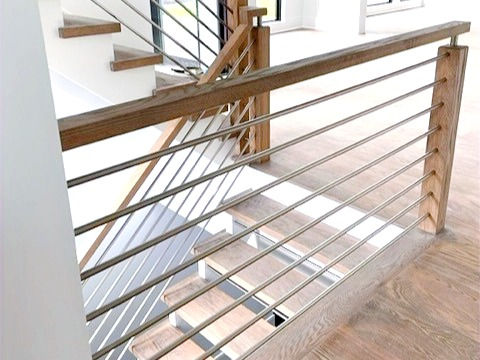
Opting for open risers gives a home a modern, airy look. If you select a stair design with open risers, you can customize the safety bars in the open space with satin black metal bars, stainless steel bars, etc. and your railing installer may coordinate your indoor handrail to match.
When selecting a handrail, you can add a lattice panel, decorative balusters, custom finials on the newel posts, or opting for custom turned balusters and handrails. Some homeowners also add custom LED lighting strips or motion sensor lighting that can change hues with control of an app!
We’ve got pets, kids, and elderly family members in the house – how do I improve the safety of my indoor wood staircase?
Adding details like runner rugs over the top of painted or stained stairs means the style can easily be customized without the hassle of refinishing. Customize the look even further by using stair carpet runner rods in your choice of metal finish and finial or decorative elements. Another great choice would be anti-slip tape strips and rubber or woven fabric stair tread pads to provide more grip than bare, varnished stairs.
Currently, the open riser staircase is very modern and trendy, but there are higher risks involved for vulnerable family members as well as animals. There is a chance that little legs and paws might slip through, or unsteady feet may get caught and injured. losed riser staircase designs will minimize those risks for many homeowners, and designs like a cantilevered stair can provide modern styling with proper safety precautions. The staff here at Pinto Carpentry would be happy to discuss safe, kid and pet friendly stair design choices with you! We’ll be able to guide you through the process of something aesthetic and safe for everyone’s needs, no problem.
As you can see, the process for selecting a stair material is much less scary and daunting than you’d think. There are a wide variety of price points and materials to select from in stair building, and lots of room for customization! We hope you’ve enjoyed our guide to picking the perfect stair material, but if you still have questions, we’re here to help.

Pinto Carpentry is a full-service woodshop specializing in indoor handrail and custom staircase builds. We have a dedicated team who are passionate about their woodworking, and would love to collaborate with you on your residential or commercial project.
Pinto Carpentry serves most regions of New Jersey for bespoke stair builds, stair replacement and repair, indoor handrail replacement and repair, and related work. Give us a call at 908-922-1778 to request a free consultation with our knowledgeable admin staff. We’ll get you set up with a customized estimate and help you through the materials selection process!
With more than 20 years of experience, you can rest easy knowing we’ll get the job done with quality materials, dedicated workmanship, and a pride in our craft like none other. There’s no project too large or too small for Pinto Carpentry – we’re a top name in local NJ handrail installation and stair builds for a reason: we do it all!
Call us today or DM us on our social media at @PintoCarpentryNJ on Instagram and Facebook.


Comments